High Quality Print

Low Prices

Free Delivery (UK Mainland)*

Friendly Team of Experts

5 Star Rated By Customers

Order Online Anytime 24*7
Typography holds a lot of power in design. The right font combination may make or break your design altering everything from readability to aesthetic appeal. When done effectively, typefaces not only optimise the visual hierarchy but also increase user engagement and strengthen a brand’s identity. Here’s how to blend typefaces successfully to get better designs.
Fonts are more than just a technique to display text; they contribute to the visual aspect of your message and influence how it should be perceived. A solid font mix may help to build hierarchy, direct the reader’s attention, and emphasise your design’s tone.
According to research by the University of Central Florida, personalised fonts improve reading speed by 35% without compromising comprehension. As a result, selecting a font is more than just making a choice. It is a practical step that determines how effectively your message is interpreted.
A basic font (Garamond, Georgia, etc) is the foundation of your design which should be used mostly for body text or bigger blocks of material. The font should be easy to read and adaptable. If you want a more modern, clean style, use sans serif fonts like Arial, Helvetica, or Open Sans; serif fonts like Times New Roman or Calibri provide a more traditional feel.
The sans-serif typeface might also be used for reception signs where the text has to be legible from a distance. The basic typeface should be bold and straightforward so that people can easily absorb the content.
To add visual hierarchy and attention to your base font, you should also opt for a second typeface to complement your main font. Headings, subheadings, and calls to action are all examples of secondary font alternatives. The foundational typeface should have sufficient contrast to stand noticed while being harmonious.
Consider using the same sans-serif typeface, such as Arial, for body text and a serif font, such as Georgia or Times New Roman, for headers. The mix of sturdy sans-serif and traditional serif will give your design a professional, balanced look.
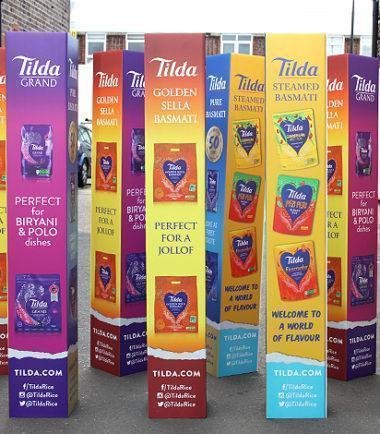
This is very handy for building exhibition display boards with huge headlines that must attract attention rapidly. When viewed from a distance, exhibition boards are often the first point of contact and if they do not stand out or give information, they are easily ignored.
It’s tempting to use many typefaces to demonstrate inventiveness but stick to two or three. Too many typefaces may be overwhelming for both the designer and the viewer. With continuous weight or style, all font families remain the same.
For example, using a bold base font for headers and a normal font for body text will help your design keep a consistent appearance and seem more professional.
Font sizes and spacing are equally crucial as font choices. Titles should be significantly larger than body content with subheadings falling somewhere in the middle. Make sure your kerning (space between letters) and leading (space between lines) aren’t packed in small sizes along with your text’s legibility at all levels.
In reception signs, the text is required to be read at various angles and distances which makes it critical to space the letters and lines adequately. Maintaining adequate space is essential so that the text does not appear cramped and your audience can interact with the material more effectively.
Before you finalise your design, you should test how your font combinations look in different settings. Print it out, view your design on different screen sizes, and check how it reads from different distances. This will make sure that your fonts look good and work well on all mediums.
It’s pretty easy to combine fonts until you realise that if those principles are not kept in mind, it becomes a nightmare. If you’re working on reception signs or exhibition display boards, the trick is to strike a balance between contrast and cohesion with your audience in mind. Fonts can elevate your design, improve readability, and improve the user experience when paired well.
Capture attention with premium, custom-printed signs and boards. Contact us now to get started on your exhibition display board design!

An enthusiastic Graphic Designer professional with strong communication and organisational skills, who is passionate about creating and developing innovative ideas with the client to help them get their business noticed. I work to the highest standards and have an excellent eye for detail with skills in design and organisation. I am a dependable and productive worker whose honesty and integrity provides effective leadership and builds excellent relationships. I enjoy innovatively…

 020 8902 9298
 Quick Quote
 020 8902 9298
  Quick Quote
  Login / Signup